
CHILDREN'S BOOK EDITORIAL SERVICES
Editorial Services
Children’s Book Editorial Services That Strengthen Your Story
A beautifully designed and printed children’s book begins with a manuscript that is ready for publication.
Writing for children can look deceptively simple. A picture book may contain only a few hundred words, but every word has a job to do. Story, pacing, vocabulary, page turns, character development, and the relationship between words and illustrations all need to work together for the intended age group.
Even experienced writers benefit from a fresh, professional perspective. A skilled children’s book editor can identify problems that are difficult to see when you’ve been immersed in your own manuscript—from gaps in the story and awkward pacing to unclear language, unnecessary repetition, inconsistencies, and small errors that can undermine an otherwise polished book.
Callawind provides professional children’s book editorial services tailored to the type of book you’re creating and the stage your manuscript has reached. Our goal isn’t to rewrite your work into someone else’s voice. It’s to make your writing clearer, stronger, and more effective while preserving the voice and ideas that make the book yours.
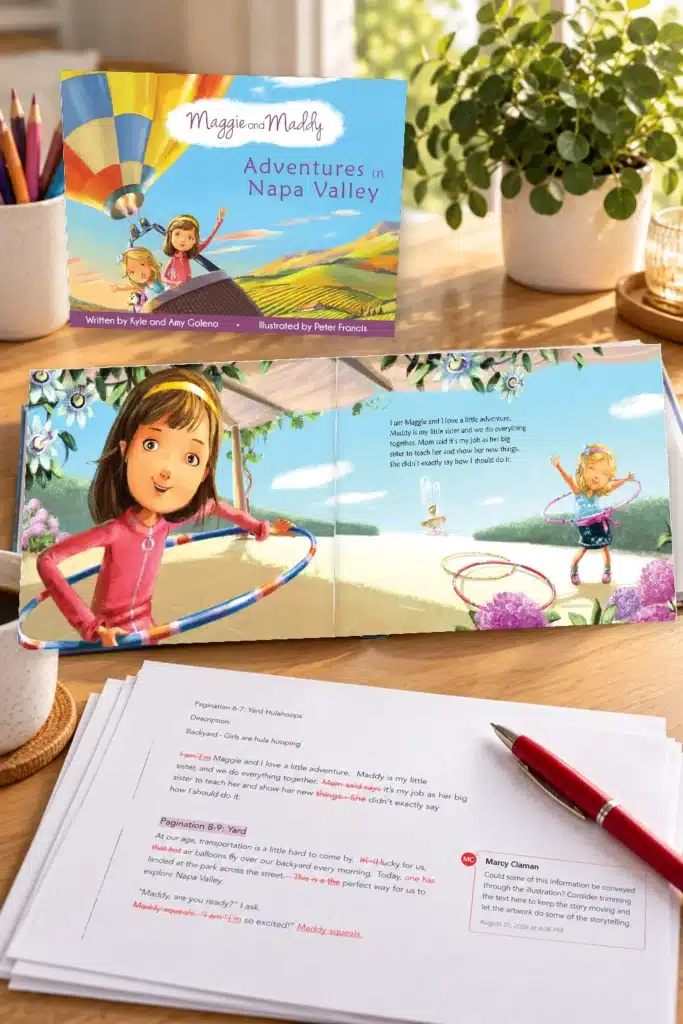

How Callawind Helps Edit Children's Books
Children’s books have their own requirements for storytelling and age-appropriate writing. The text also needs to work with the illustrations rather than simply describe what the pictures already show.
Depending on the manuscript and intended readership, a children’s book editor may consider:
- The strengths and weaknesses of the story
- Plot, pacing, and character development
- Clarity and economy of language
- Age-appropriate vocabulary and sentence structure
- Consistency of tone and point of view
- Opportunities for the illustrations to carry part of the storytelling
- Page turns and the distribution of text throughout the book
- Whether the manuscript is appropriate for its intended age group and book format
For illustrated books, editorial decisions can also affect design and production. Word count, pagination, page turns, and illustration requirements all influence how the finished book will work. Addressing these elements before design begins can help prevent unnecessary revisions and costly changes later in the publishing process.
What Kind of Editing Do You Need?
Developmental or Structural Editing
A big-picture review of the manuscript, looking at story, structure, pacing, clarity, content, character development, age appropriateness, and overall effectiveness.
For children’s books, developmental editing may also consider how the text could be divided across pages or spreads, where page turns occur, and how much of the storytelling can be left to the illustrations.
Copyediting
A detailed edit focusing on grammar, spelling, punctuation, sentence structure, consistency, word choice, and readability.
For children’s manuscripts, copyediting also considers whether the language, sentence length, tone, and vocabulary are appropriate for the intended reader.
Proofreading
The final editorial check after the book has been designed and laid out. Proofreading focuses on typographical errors, formatting inconsistencies, and other problems that may have been introduced or missed during earlier stages of production.
Depending on the book, we can also assist with rewriting, fact checking, editorial research, and other specialized editorial requirements.
Editing with the Finished Book in Mind
Editing doesn’t happen in isolation. Decisions made during the editorial stage can affect page count, illustration requirements, page layout, printing specifications, and the cost of producing your book.
Because Callawind can manage your project from manuscript through design, prepress, printing, and production, we consider editorial decisions in the context of the finished book.
Other Books We Edit
Although children’s books are our specialty, Callawind also provides professional editorial services for selected illustrated, nonfiction, and specialty publishing projects.
Cookbook Editing
Cookbooks require a particularly rigorous kind of editing. A recipe isn’t simply prose—it’s a set of instructions that someone must be able to reproduce successfully in their own kitchen.
A cookbook editor reviews each recipe for missing ingredients or instructions, ingredients that appear in the method but not in the ingredient list, confusing or incomplete directions, inconsistent terminology and measurements, recipe structure and formatting, missing or incorrect yields, oven temperatures and cooking times, and consistency across recipes, headnotes, sidebars, and other content.
This attention to detail helps make a cookbook not only enjoyable to read, but reliable and easy to use.
Nonfiction & Specialty Book Editing
We also provide editorial support for illustrated nonfiction, educational publications, art and museum books, business books, corporate publications, and other specialty projects.
Depending on the subject and complexity of the book, this may include structural editing, copyediting, proofreading, fact checking, caption editing, consistency checks, and coordination of material supplied by multiple contributors.
For books containing substantial reference material, we can also arrange professional back-of-the-book indexing.
Editorial Services FAQs
How do you charge for children’s book editing?
Editorial services are usually charged by the hour. Once we review your manuscript and determine the level of editing required, we’ll estimate the number of hours needed and provide a project cost range before work begins.
The cost depends on factors such as the length and complexity of the manuscript, its current condition, and whether you require developmental editing, copyediting, proofreading, or other editorial services.
How does the editing process work?
Editing is typically done electronically, most often in Microsoft Word using Track Changes and Comments. This allows you to see suggested revisions, questions, and editorial comments while retaining control over the changes made to your manuscript.
For developmental or structural editing, you may also receive a separate editorial report with broader recommendations about story, pacing, character development, organization, age appropriateness, and other big-picture issues.
Once the manuscript has been finalized and the book has been designed, proofreading is generally completed on the laid-out pages before the files are sent to print.
Should my children’s book be edited before the illustrations are created?
Ideally, yes. Changes to text, pacing, pagination, and page turns are much easier to make before an illustrator has completed the finished artwork.
Finalizing the manuscript first can help reduce unnecessary illustration revisions and ensure that the illustrator is working from the strongest version of the text.